
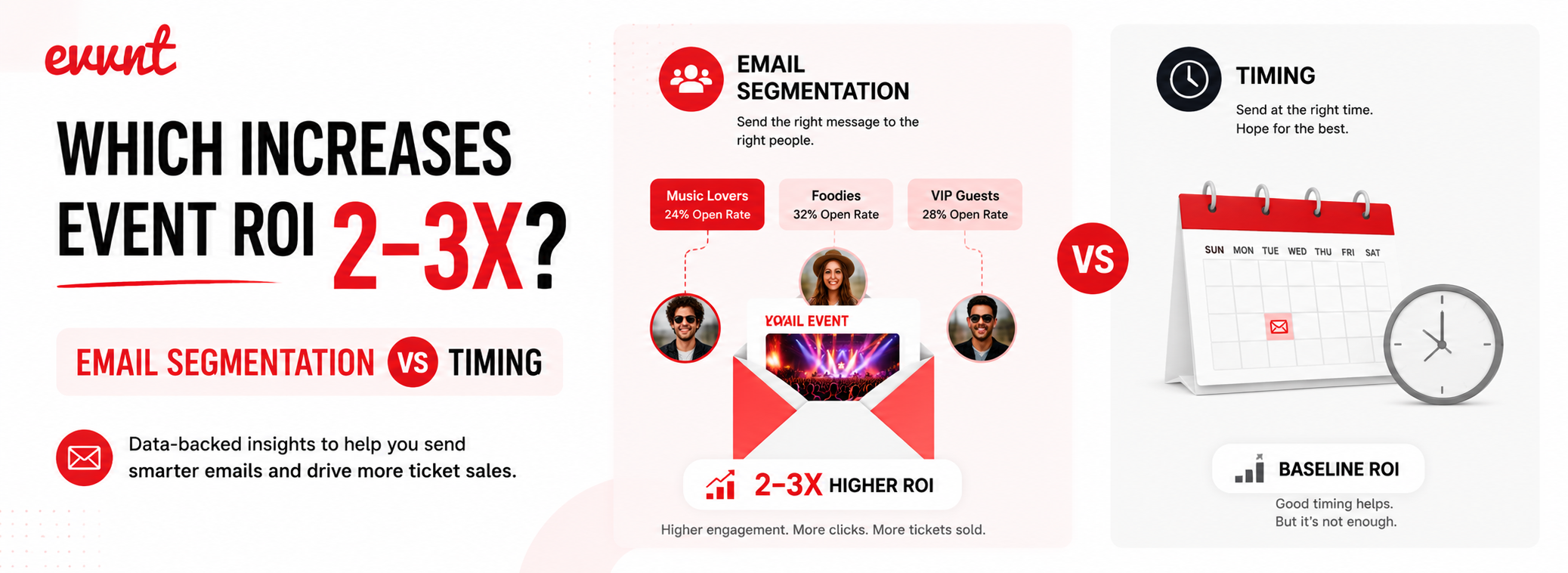
We’ve been using AI to do deep research on the event industry. We’ve built a custom GPT that is being fed data from all parts of event marketing, just so we can do fun, nerdy deep dives like this one of event email marketing.
AI Deep Research Prompt: Why event marketers see 2-3x ROI differences from email strategies — segmentation vs timing tradeoffs across event types
Executive Summary:
Segmentation drives the biggest revenue gains in event email marketing.
Timing fine-tunes performance.
Marketers see 2–3x ROI differences primarily because segmentation changes who gets what message, which directly affects conversion rates.
Timing mostly changes when people see the email, which affects engagement (opens and clicks).
Segmentation tends to drive the big revenue jumps; timing then fine‑tunes performance, and their relative payoff shifts by event type.
When you know this, it greatly helps inform the precision of your event email marketing campaigns.
This is why when Evvnt was building our Premium Email Marketing tool we made sure to include both segmentation through categories and zip codes and still give you the option to pick the best possible time for your send. It’s amazing for those just getting started with event email marketing campaigns.
Why ROI Swings So Much Between Email Strategies
-
Email as a channel already averages roughly 36:1 ROI across industries, meaning 36 units of revenue per 1 unit spent.
-
When you layer in strong personalization and segmentation, ROI can climb toward 40–45:1 or more—roughly 2–3x higher than brands that rarely segment or personalize.
-
By contrast, timing optimization usually yields incremental lifts: higher opens and clicks (e.g., 10–40% better engagement), which may translate to 10–40% more revenue, not 200–300% by itself.
In other words:
-
Segmentation changes conversion probability (is this event relevant enough for me to buy/RSVP?).
-
Timing changes engagement opportunity (do I even see this email and have the mental bandwidth to act?).
For event programs, the marketers who combine both—strong segment logic plus behavior‑based send times—are the ones who consistently report 2–3x revenue per recipient vs “same email to everyone on Tuesday at 10 a.m.”.
What Segmentation Actually Does to ROI
Measured impact of segmentation
Multiple studies and benchmarks show that:
-
Segmented campaigns drive:
-
30–50% higher open rates and up to ~100% higher click‑throughs vs non‑segmented sends.
-
Around 2x higher conversion rates in some benchmarks.
-
Roughly 3x revenue per recipient in high‑segmentation programs (e.g., 0.19 vs 0.06 revenue per recipient).
-
-
Industry meta‑analyses attribute anywhere from 30% of email revenue up to “hundreds of percent” uplift to segmentation and personalization in aggregate.
-
Individual case studies show 100–140%+ increases in revenue per campaign when moving from broad blasts to behavior/interest‑based segments.
For events, that translates to:
-
Higher paid ticket conversion from:
-
Segmenting past attendees vs new prospects.
-
Targeting genre/interest segments with the right artists or themes.
-
Focusing “VIP upgrade” offers on people with high historical spend.
-
-
Higher RSVP and show‑up rates from:
-
Treating registered vs unregistered differently (information vs persuasion).
-
Segmenting locals near the venue vs those who must travel.
-
Why segmentation multiplies revenue
Behaviorally, segmentation works for events because it:
-
Increases relevance: Content reflects people’s interests (music style, topic track), location, spend level, and past behavior, making the event feel “for me.”
-
Reduces decision friction: Targeted emails can address segment‑specific objections (e.g., parking and childcare for local parents vs schedule conflicts for professionals).
-
Strengthens social proof: You can show testimonials, photos, or stats from “people like you” (past VIPs, same city, same industry), which is much more persuasive than generic hype.
Because event decisions are discretionary (I don’t have to go), these psychological levers show up as outsized changes in conversion rate—hence 2–3x ROI gaps between good and poor segmentation practices.
What Timing Actually Does to ROI
Measured impact of timing
Recent timing benchmarks and send‑time optimization data show:
-
“Best practice” windows (e.g., Tuesdays/Thursdays, 10 a.m.–3 p.m.) do improve open and click rates versus random timing, but they mainly move engagement, not necessarily conversion quality.
-
Large‑scale analyses have found:
-
Evening sends (around 8–9 p.m.) can achieve peak opens and CTR, e.g., 59% open rate at 8 p.m. in some data vs ~45% at 2 p.m.
-
AI send‑time optimization can increase open rates by about 23% and revenue by roughly 30–40% compared to static send times.
-
-
Hotel and hospitality case studies isolating timing (with creative and segmentation held constant) often see solid but not explosive gains—ex: midweek timing improving opens and click‑to‑open rates in stay‑focused campaigns, but not 5–10x changes.
So timing clearly matters, but it usually shifts ROI by tens of percent, not multiples—unless your previous timing was very poor.
Why timing still matters a lot for events
Events are time‑sensitive and local, so timing can materially change whether someone sees your campaign in the decision window:
-
For high‑ticket or travel‑worthy events, people research earlier in the week and during planning hours; midweek sends align with “trip planning” behavior.
-
For local or low‑ticket events, decisions often happen closer to the date and later in the day; evening timing and week‑of sends map to impulse decisions (e.g., “What are we doing Friday?”).
-
For reminders (24‑hour and day‑of), timing directly affects show‑up rates: sending too early (e.g., 3 days before with no same‑day reminder) leaves room for forgetfulness and competing plans.
So timing often determines who sees the email at the moment that matters, which can move attendance and final revenue, but it’s working on top of the underlying segmentation and offer quality.
Segmentation vs Timing by Event Type
1. High‑ticket events (conferences, festivals, premium shows)
-
Segmentation impact: Very high
-
Segment by past spend, past attendance, topic/genre interest, and geography (willingness to travel).
-
Tailored messages (VIP upgrades, payment plans, track‑specific highlights) can easily produce 2–3x higher revenue per recipient vs generic blasts, because conversion rates matter much more at high price points.
-
-
Timing impact: Moderate to high
-
Longer consideration windows mean timing across the campaign arc matters: early‑bird deadlines, payday proximity, and midweek planning peaks.
-
But if emails go to the wrong people (poor segmentation), perfect timing still won’t fix low relevance.
-
Tradeoff: For high‑ticket events, invest first in segmentation (who gets what offer, what proof, what price tier), then refine timing (midweek, early‑bird cut‑off emails, pay‑day clustering). Timing lifts a well‑segmented strategy; it rarely rescues a bad one.
2. Low‑ticket / impulse‑driven local events (bars, clubs, small venues)
-
Segmentation impact: Moderate to high
-
Segment by genre/interest, neighborhood, age band, and recency of attendance; even basic filtering (e.g., rock vs EDM list) can meaningfully improve CTR and conversion.
-
-
Timing impact: High
-
Decisions are often made within 1–7 days (or same‑day), and engagement data shows evening and late‑afternoon sends can significantly outperform generic 9 a.m. blasts for leisure content.
-
Weekday vs weekend timing matters a lot (e.g., Thursday evenings for weekend shows, day‑of reminders for walk‑up traffic).
-
Tradeoff: Here, segmentation and timing are closer in weight. A decent interest‑based segment plus great send‑time alignment (e.g., evening emails as people plan nights out) can rival or exceed very fine‑grained segmentation sent at the wrong time.
3. Free and RSVP‑based events (workshops, open houses, community events)
-
Segmentation impact: High on quality (who shows), moderate on raw volume
-
Targeting past attendees, specific interest segments, and local proximity increases RSVP quality and eventual show‑up rates.
-
-
Timing impact: High on attendance
-
Free events suffer from flakiness; well‑timed reminders (7 days, 24 hours, and day‑of) significantly reduce no‑shows even if segmentation is basic.
-
For RSVP campaigns, timing of follow‑ups to “clicked but not registered” is crucial: hitting them within 24–72 hours while the intent is warm converts better than waiting a week.
-
Tradeoff: For free/RSVP events, you often feel timing more acutely in attendance metrics, while segmentation affects downstream monetization (donations, paid upsells, membership conversions).
4. Recurring vs one‑time events
-
Recurring series:
-
Segmentation over time (by engagement, visit frequency, and spend) steadily compounds ROI—e.g., loyalty segments, lapsed‑attendee win‑backs.
-
Timing becomes about habituation: consistent weekly slots (e.g., “this week at [Venue]” every Monday at 10 a.m.) plus event‑specific reminders at optimal hours.
-
-
One‑time tentpoles:
-
Segmentation around high‑value clusters (VIPs, superfans, past attendees) plus geographic radius becomes a major revenue lever.
-
Timing across the build‑up (announcement, early bird, last chance) shapes the revenue curve, but again, only for people who actually care.
-
How to Think About the Tradeoff in Practice
1. Build a simple revenue model
Conceptually, event email revenue per recipient is:
RPR=Open rate×Click‑to‑open×Conversion rate×Average order value
-
Segmentation mainly affects:
-
Click‑to‑open (content relevance)
-
Conversion rate (offer/objection match)
-
AOV (which segments see higher‑tier offers or bundles)
-
-
Timing mainly affects:
-
Open rate
-
Sometimes click‑to‑open, if people are more willing to engage at certain times.
-
If segmentation doubles your CTR and conversion, your RPR may legitimately 2–3x even at the same open rate. If timing improves opens by 20–30% but the underlying CTR and conversion are flat, you’ll usually see a smaller revenue bump.
2. Where to focus first by maturity
-
Early‑stage event programs:
-
First: Clean the list (remove hard bounces, re‑engage or suppress chronically inactive subscribers) and add 2–3 meaningful segments (past attendees, locals within X miles, interest/genre).
-
Then: Adopt 1–2 “best guess” timing windows (midweek + evening) and A/B test them.
-
-
Mature programs (multiple events, years of data):
-
First: Deepen segmentation (intent, lifecycle, spend tiers) and event‑type mapping.
-
Then: Turn on send‑time optimization or per‑segment timing rules (e.g., weekday planners vs weekend browsers).
-
3. Event‑specific optimization loops
For each major event type in your portfolio:
-
Define critical segments (e.g., past attendees of similar events, high‑value locals, first‑timers).
-
Map decision windows (how far out do people usually buy or RSVP, and on what days/times do they respond best?).
-
Test send times within each segment rather than globally.
-
Measure revenue per recipient by segment and timing, not just opens or CTR.
You’ll often find that:
-
Segmentation explains most of the variance in RPR between campaigns (the 2–3x swings).
-
Timing explains much of the remaining variance within a segment (e.g., +25–40% uplift on top of good segmentation).